Oct 29, 2026FAQs
Built-in GPS vs External GPS Dash Cam: Which Is Better?
Choosing between a built-in GPS and an external GPS dash cam can affect installation, tracking accuracy, and overall driving experience.
Built-in GPS vs External GPS Dash Cam: Which Is Better?
Choosing between a built-in GPS and an external GPS dash cam can affect installation, tracking accuracy, and overall driving experience. Both options provide location data and vehicle speed information, but they differ in design, flexibility, and application. Understanding these differences can help you choose the right dash cam for personal driving or fleet management.
What Is a Built-in GPS Dash Cam?
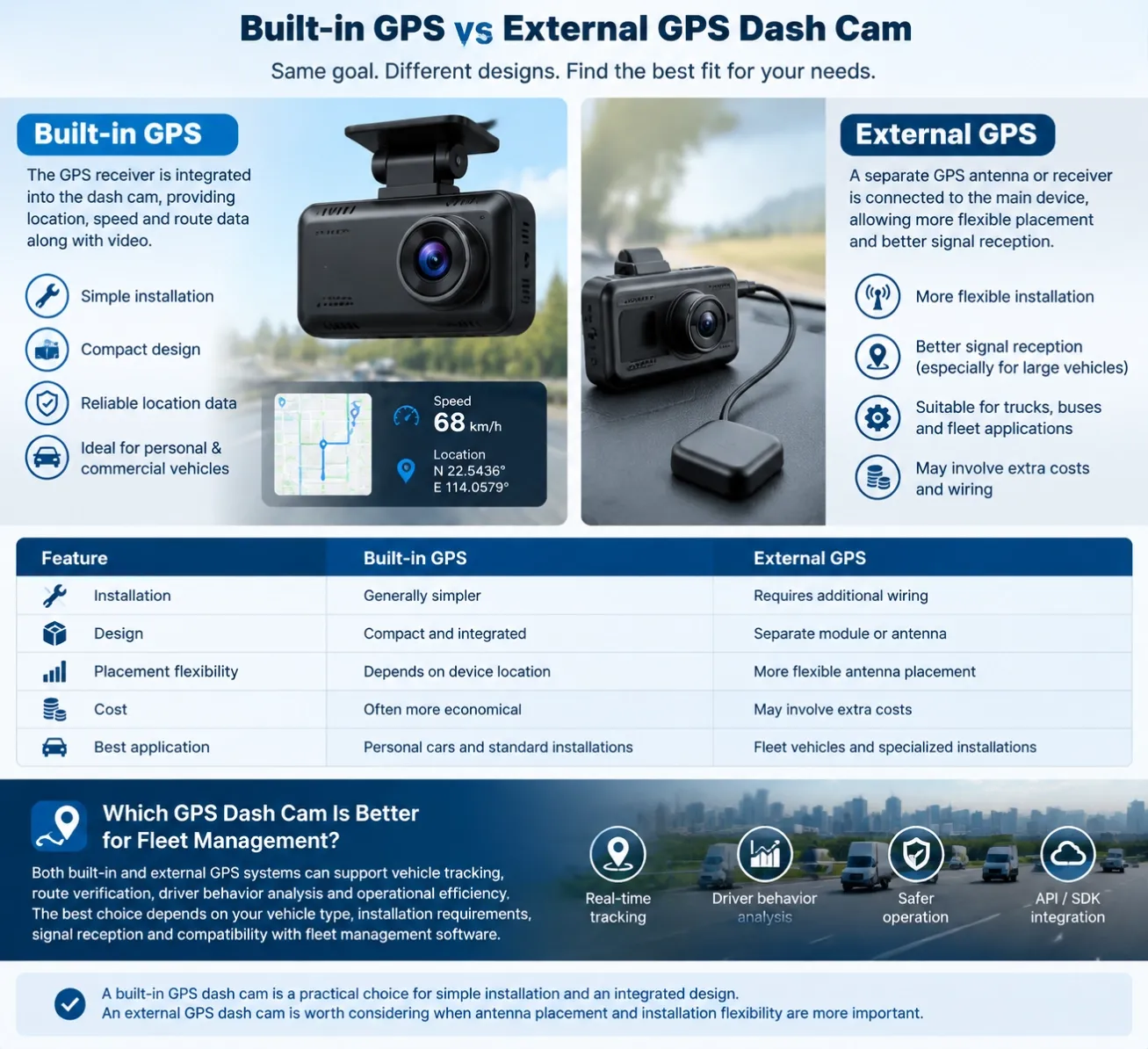
A built-in GPS dash cam has a GPS receiver integrated into the device or its internal hardware design. It receives satellite signals to record vehicle location, speed, and route information alongside video footage.
The main advantage is convenience. With fewer external components, installation is generally simpler, and the system has a cleaner appearance. Built-in GPS is ideal for private vehicles, commercial vehicles, and users who want reliable location information without additional accessories.
However, GPS signal reception can be affected by the device's installation position, vehicle structure, and surrounding environment. If the receiver is poorly positioned, performance may be reduced.
What Is an External GPS Dash Cam?
An external GPS dash cam uses a separate GPS antenna or receiver connected to the main device. Depending on the design, the external module can be positioned in a location with better satellite signal reception.
This configuration offers greater installation flexibility. It can be particularly useful in commercial vehicles, trucks, buses, and fleet applications where the dash cam may be installed in a location that does not provide optimal GPS reception.
The main disadvantages are additional wiring, installation complexity, and potential extra costs. Compatibility between the GPS module and the dash cam should also be confirmed before purchase.
Built-in GPS vs External GPS: Key Differences
Feature | Built-in GPS | External GPS |
|---|---|---|
Installation | Generally simpler | Requires additional wiring |
Design | Compact and integrated | Separate module or antenna |
Placement flexibility | Depends on device location | More flexible antenna placement |
Cost | Often more economical | May involve extra costs |
Best application | Personal cars and standard installations | Fleet vehicles and specialized installations |
Which GPS Dash Cam Is Better for Fleet Management?
For fleet operators, GPS functionality is important for vehicle tracking, route verification, driver behavior analysis, and operational efficiency. Both built-in and external GPS systems can support these functions when properly configured.
The best choice depends on vehicle type, installation requirements, signal reception, and compatibility with fleet management software. Businesses using 4G dash cams should also check whether GPS data can be uploaded to their management platform in real time.
For large fleets, selecting a dash cam that supports GPS tracking, remote video access, and API or SDK integration can help streamline vehicle management.
Conclusion
A built-in GPS dash cam is a practical choice for users who prioritize simple installation and an integrated design. An external GPS dash cam is worth considering when antenna placement and installation flexibility are more important.
Before purchasing, evaluate your vehicle type, tracking requirements, and software compatibility to ensure the GPS dash cam meets your needs.